
May 2026:

Click here to check out free, downloadable REAC Resources including the new NSPIRE Self-Inspection Checklist!
New Training Dates TBD due to NSPIRE Standard Updates this Summer!
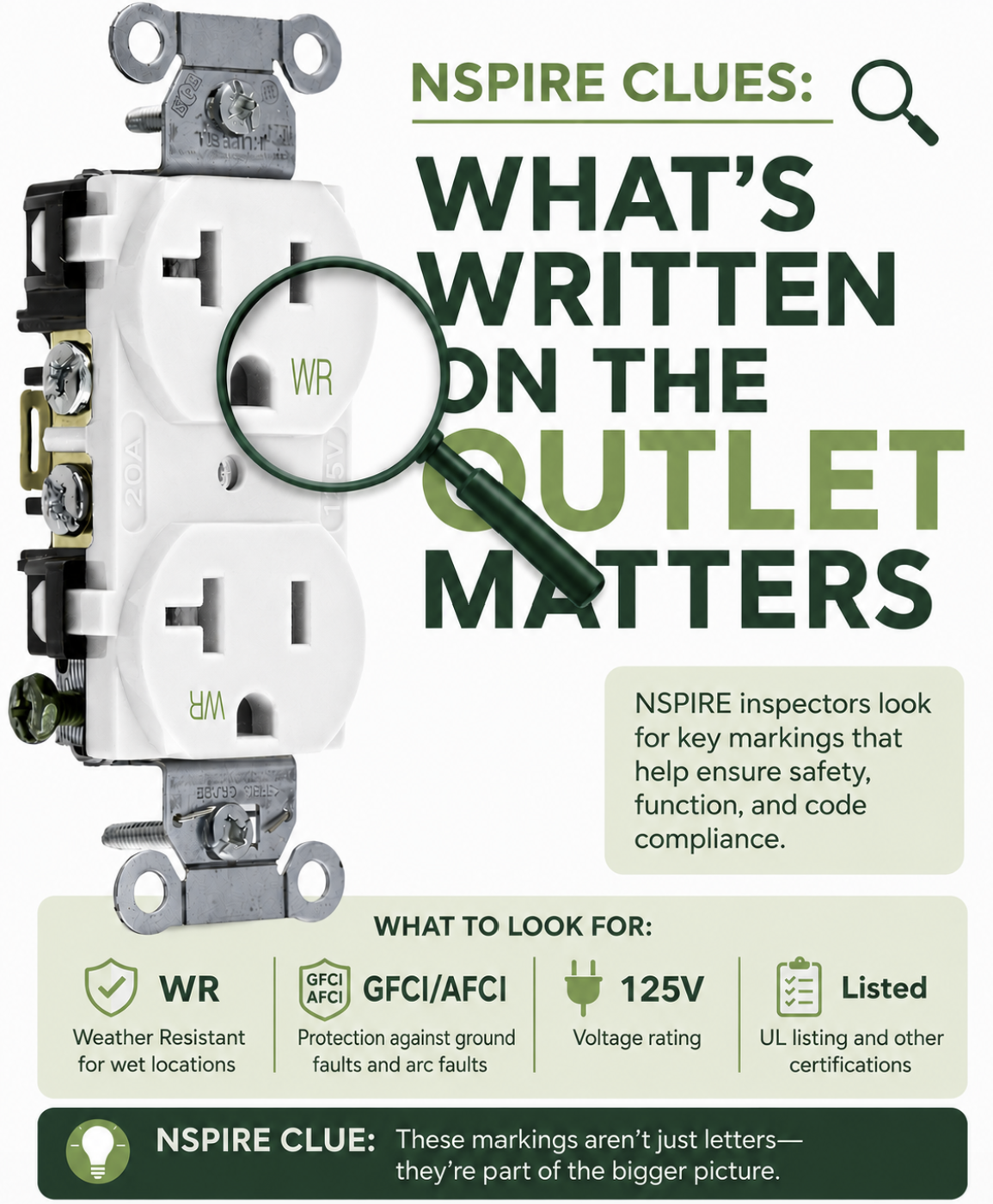
In this May Newsletter, I am going to go over some over-looked markings on outlet receptacles and how they can impact your NSPIRE inspection.
Outdoor Weather-Resistant (WR) Receptacles:
Under NSPIRE, ALL receptacles located Outside must be GFCI-protected (regardless of when the property was built although Code started requiring them in 1975).
The National Electric Code Section 406 states they must ALSO be Weather-Resistant (WR) AND have a weatherproof cover.


While a missing WR on an Outdoor outlet receptacle is NOT an NSPIRE deficiency, numerous companies/agencies are installing the wrong GFCI’s Outside and this is highly dangerous.
GFCI Receptacles:
Speaking of GFCI’s (Ground Fault Circuit Interrupters) – make sure you receive what you purchased!
I recently conducted a Pre-NSPIRE inspection at a property where all of their “GFCI’s” in the bathrooms and kitchens (wet locations) looked like this:

Needless to say, the maintenance was pretty upset to have to now replace every single one of them…but GREAT that we caught it before their NSPIRE inspection!
AFCI receptacles are only typically installed when you cannot install an AFCI breaker in the panel due to various reasons.
Amperage:
Have you ever wondered why some neutrals have a T-shape? It doesn’t matter for NSPIRE, but this is crazy important to prevent nuisance tripping and/or fires.

Here is a great chart to memorize:

Tamper-Resistant (TR)
With a few exceptions (NEC 406.12), all dwelling unit outlet receptacles must be Tamper Resistant (TR).
While the Code does not require the TR to be marked on the face of the receptacle, MOST manufacturers do place the marking.
Does it matter for NSPIRE? Nope – but following Code is even more important
Tamper-resistant does not mean vandal-resistant or difficult to remove. It means the receptacle contains internal shutters that block access to energized parts unless both plug blades are inserted simultaneously. This safety feature helps prevent shock injuries from foreign objects inserted into receptacle slots.

Here are the locations a TR listing is NOT required by Code:

Lastly, here is a nice summary chart with the National Electric Code (NEC) references:

Please reach out to me for consulting, Pre-NSPIRE inspections, training, appeals, or if you just have a question!
Resources
HUD has PDFs (videos are currently down) on how to appeal and how to close out H&S deficiencies here:
NSPIRE Toolkit
**Remember, if you will be appealing something that was cited,
your “defect mitigation in 24 hours” is that you are appealing…not that you fixed it!**
To subscribe to this free monthly newsletter and read newsletters you may have missed, click here: C4N6 Newsletter Registration and Archive