
March 2026:
“Loose” Outlet Receptacles?
Click here to check out free, downloadable REAC Resources
In this March Newsletter, I am going to show you when a “loose” outlet receptacle is or isn’t a deficiency as well as specifically which deficiency as defined by the NSPIRE Standards.
There has been a marked increase in citations of “loose” outlet receptacles which, by that description, is difficult to appeal.
There is a huge difference between a loose cover plate, loose connection inside the receptacle or the entire receptacle and cover plate are loose.
Entire Receptacle and Cover Plate are Loose
It’s difficult to show an image of an outlet receptacle that is not attached to the framing in the wall (or needs securing wings if no stud is available) …but I’m sure you get the picture. In this situation, the entire receptacle and cover plate wiggles back and forth.
IT IS A CODE ISSUE ONLY!!!
Loose Cover Plate
It really depends on how loose the cover plate is. If the screw is just a little loose, I call out that I have a screw loose (Ha!) and maintenance come running to tighten it.
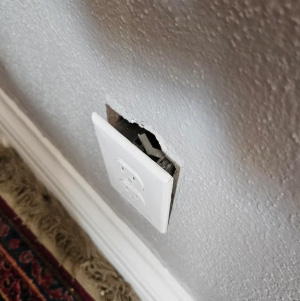
However, if your cover plates look like either of these images…it’s an Exposed Conductor Deficiency #4 defect (NOT a damaged Outlet/Switch defect).
Yes, a missing screw is the same as a missing outlet cover plate.

Loose Connection INSIDE the Receptacle:
This issue is the one that gets misrecorded during the inspection the most as Electrical Conductor Outlet & Switch Standard Deficiency #1 – “Outlet or Switch is Damaged” – a Life-Threatening H&S. This defect should ONLY be cited if the outlet receptacle itself is damaged or the switch toggle is damaged/missing to the point of electrical shock.
Loose, flickering tester lights, or power-losing outlets when the circuit tester moves are usually caused by worn-out internal contact springs, loose wiring connections, or faulty installation.
Key Causes and Fixes:
- Worn Internal Contacts: Over time, the metal clips inside the outlet lose their tension, failing to hold plug prongs securely. Replace the outlet.
- Loose Terminal Screws: The wiring connections behind the outlet may have loosened, causing intermittent power. Turn off the breaker and check for tight, secure connections.
- Push-in Connectors Failure: Using the “push-in” slots on the back of outlets is less secure than wrapping wires around terminal screws (side wiring).
- Loose Outlet in Box: If the outlet itself is not tightly screwed into the electrical box, it can move and lose contact.

THIS SHOULD BE CITED AS Electrical Conductor Outlet & Switch Standard
DEFICIENCY #2 –
“TESTING INDICATES A THREE-PRONGED OUTLET IS NOT PROPERLY WIRED OR GROUNDED.”
(A Severe Health & Safety)

THIS SHOULD BE CITED AS Electrical Conductor Outlet & Switch Standard
DEFICIENCY #3 –
“OUTLET DOES NOT HAVE VISIBLE DAMAGE AND TESTING INDICATES IT IS NOT ENERGIZED.
(A Severe Health & Safety)
Bottom Line:
When your residents complain that their “plugs don’t stay in” or their “outlets have no power,” make sure you prioritize the repair to protect lives, property and to avoid a ‘Fail’ or high-scoring deficiency on your NSPIRE inspection!
Resources
HUD has PDFs (videos are currently down) on how to appeal and how to close out H&S deficiencies here:
NSPIRE Toolkit
**Remember, if you will be appealing something that was cited,
your “defect mitigation in 24 hours” is that you are appealing…not that you fixed it!**
To subscribe to this free monthly newsletter and read newsletters you may have missed, click here: C4N6 Newsletter Registration and Archive